
Eldenhall Sciences
About Eldenhall Sciences
Eldenhall Sciences Inc. is an academic publisher based in Harrisonville, Missouri, in the United States. It publishes peer-reviewed, open access journals. Augmented Medicine and Global Economies launched in 2026 and are open for submissions to Volume 1.
Who we are
Eldenhall Sciences Inc. is a U.S. company based at 117 South Lexington Street, Suite 100, Harrisonville, Missouri. It owns its journals and provides what their editors need to run them: the submission and peer review system, the editorial office, copyediting and production, and this website.

Key facts
- Journals
- Augmented Medicine (Artificial Intelligence in Health and Medicine) and Global Economies (Economics, Finance and Public Policy)
- First volume
- Volume 1 (2026) for the journals open today
- Publication model
- Continuous publication: articles appear online as soon as they are ready and are collected in one volume per year
- Access and license
- Open access under CC BY 4.0, with no subscription or reading fees
- Peer review
- Double-blind, with at least two independent reviewers for every manuscript sent for review
- Language
- English; accepted articles are copyedited to American English
- DOIs
- Not yet assigned; Crossref membership is pending
- Indexing
- Not yet indexed. Each journal will apply to DOAJ, Scopus, Web of Science and the relevant subject databases when it meets their eligibility criteria.
- Citation metrics
- None. The journals have no impact factor, CiteScore or other citation metric, and this site does not display any.
- Memberships
- None at present. Eldenhall Sciences is not a member of the Committee on Publication Ethics (COPE).
- Society or institutional affiliation
- None. The journals are not owned by, or published on behalf of, a learned society, university or other organization.
Our journals

Augmented Medicine
Artificial Intelligence in Health and Medicine. Augmented Medicine publishes research on how artificial intelligence is developed, evaluated, implemented and governed in clinical care, public health and health systems. The journal treats an AI system used in care as an intervention to be evaluated, not only as a technical achievement: it asks whether the system works, for whom, in which setting and with what risks, and it expects studies to be reported in enough detail for others to check them. Manuscripts are handled in six sections: Clinical Decision Support; Medical Imaging; Large Language Models in Medicine; Digital Health and Wearables; Health Data Science; and AI Safety, Ethics and Regulation. Research in any section may use any suitable design, from model development with external validation to randomized trials and studies of systems in routine use.
Global Economies
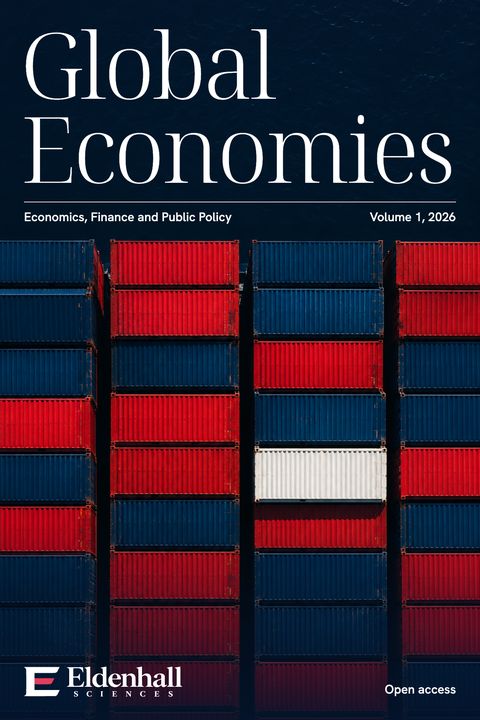
Economics, Finance and Public Policy. Global Economies publishes theoretical, empirical, experimental and computational research, from every field of economics and financial economics, on how markets and financial systems work, how households, firms, financial institutions and governments make decisions, and how public policy and regulation change economic and financial outcomes. Papers are judged on the importance of the question, the credibility of the analysis and the clarity of the contribution, not on their method or the direction of their results. Manuscripts are handled in eight sections: Macroeconomics and Monetary Policy; Asset Pricing and Financial Markets; Corporate Finance and Governance; Banking, Intermediation and Household Finance; Public Finance; Labor and Development; International Trade and Finance; and Behavioral and Experimental Economics. Papers in other fields, such as industrial organization or environmental economics, are considered when they speak to markets, financial systems or public policy.
Why we publish these journals
Research on artificial intelligence in medicine and research on economic policy are both used outside universities: by clinicians, health systems and regulators, and by governments, central banks and policy analysts, in decisions that affect patients and the public. That has two consequences for how both journals are run.
The research should be free to read. Every article is open access from the day it is published, so the people who act on it can read it whether or not their organization subscribes to journals.
The research should be possible to check. Work that informs clinical or policy decisions has to be reported fully enough for others to scrutinize and reproduce it. Augmented Medicine requires authors to report against the established guideline for their study design, such as TRIPOD+AI for prediction models or CONSORT-AI for randomized trials, and to state whether their data, code and models are available. Global Economies asks every author for a disclosure statement and requires the data and code behind empirical results to be deposited so that the results can be reproduced.
How the journals are run
Editorial independence
Each journal is to be led by an Editor-in-Chief and an editorial board of active researchers, and the editors alone decide what the journal publishes. Eldenhall Sciences staff run the editorial office and production but take no part in decisions on manuscripts. Commercial considerations, including any fees, play no part in those decisions. The editorial independence policy sets out how this separation works.
The editorial boards of our journals are being appointed, and neither journal's Editor-in-Chief has yet been appointed. Each journal's editorial board page lists editors as they are appointed, with their affiliations, countries and ORCID iDs, and shows any position not yet filled as "Appointment in progress". No one is listed without their written agreement to serve.
Peer review
Peer review is double-blind, also called double-anonymized: reviewers are not told who the authors are, and authors are not told who the reviewers are. Every manuscript sent for review is assessed by at least two independent reviewers. Reviewers advise and the editors decide, on the merit of the work and its fit with the journal. We do not guarantee acceptance, and we do not offer paid or expedited review. The full process is described in the peer review policy.
Open access
Every article is free to read and download from the day it is published, with no subscription, registration or embargo. Articles are published under the Creative Commons Attribution 4.0 International license (CC BY 4.0), which allows anyone to share and adapt the work for any purpose, provided the authors and the source are credited. Authors keep the copyright in their articles.
There is no fee to submit a manuscript. Whether an article processing charge will apply to accepted articles has not yet been decided; the fees policy explains how any charge would be introduced, and each journal's processing charges page (Augmented Medicine, Global Economies) shows the current position.
Ownership and governance
Augmented Medicine and Global Economies are owned and published by Eldenhall Sciences Inc. The company appoints each journal's editors, provides the staff and systems that support them, and is responsible for the journals' finances and business operations. It does not make editorial decisions.
Editors are appointed for their qualifications and research record. Once an Editor-in-Chief is in place, other editors are appointed on the Editor-in-Chief's recommendation. Each board will include at least five editors with relevant expertise, drawn from several institutions and countries.
The names and roles of the officers who manage Eldenhall Sciences Inc. are being added to the ownership and management policy.
The costs of publishing the journals are met by Eldenhall Sciences Inc.; readers pay nothing. Ownership, management and sources of revenue are set out in the ownership and management policy; advertising and marketing are covered by the advertising and direct marketing policy.
Standards we follow
The ethical standards that apply to authors, reviewers, editors and the publisher, and the action the editors take when malpractice is suspected, are set out in the publication ethics and malpractice statement, which links to every policy. The bodies whose guidance it follows are listed below.
- Committee on Publication Ethics (COPE)
- The journals follow the guidance and flowcharts published by COPE when handling concerns about submitted or published work, and apply the standards of the Code of Conduct for COPE Members, which COPE published on July 21, 2026, to replace the COPE Core Practices, retired in 2024. Our policies also cover each of the ten areas of the former Core Practices: allegations of misconduct; authorship and contributorship; complaints and appeals; conflicts of interest; data and reproducibility; ethical oversight; intellectual property; journal management; peer review processes; and post-publication discussions and corrections. Eldenhall Sciences is not a member of COPE. COPE considers complaints only about its members, so complaints about our journals are handled under our own complaints procedure.
- Principles of Transparency and Best Practice in Scholarly Publishing
- The Principles published jointly by COPE, the Directory of Open Access Journals (DOAJ), the Open Access Scholarly Publishing Association (OASPA) and the World Association of Medical Editors (WAME), currently in version 5.0 (October 2026), set out what a scholarly journal should disclose and how it should operate. We publish the information they call for, including ownership, editorial process, fees, licensing and contact details, and we say plainly when something, such as an ISSN, is not yet in place.
- ICMJE Recommendations
- Our journals apply the authorship criteria of the International Committee of Medical Journal Editors (ICMJE). Augmented Medicine follows the ICMJE Recommendations (updated January 2026), including disclosure of interests on the ICMJE form, registration of clinical trials before the first participant is enrolled, and data sharing statements for trials.
- Reporting guidelines
- Augmented Medicine requires the reporting guideline that matches each study design, as listed by the EQUATOR Network, used together with its AI extension where one exists.
- Standards in economics
- The disclosure requirements of Global Economies are modeled on the disclosure policy of the American Economic Association, and field experiments must be registered in a public registry, such as the AEA RCT Registry, before submission.
Contact
Eldenhall Sciences Inc., 117 South Lexington Street, Suite 100, Harrisonville, MO 64701, United States.
- Editorial office: editorial@eldenhall.org
- Augmented Medicine: augmentedmedicine@eldenhall.org
- Global Economies: globaleconomies@eldenhall.org
- Production, proofs and corrections: editorial@eldenhall.org
- Complaints: complaints@eldenhall.org
- Security vulnerabilities in this website: security@eldenhall.org
The contact page explains which address to use for each kind of question.