
Fixing the triggers: making extended unemployment benefits arrive on time in the next U.S. recession
Abstract
The permanent U.S. program for extending unemployment insurance in recessions, Extended Benefits, has rarely delivered timely support, and Congress has relied instead on emergency legislation that arrives with a delay. Applying current and proposed trigger rules to two stylized recessions, we find that the mandatory trigger never activates when the insured unemployment rate is 30 percent of the total rate. The optional trigger activates 7 to 11 months into a recession and, in a prolonged downturn, switches off after 29 months while unemployment is above 9 percent, because of its lookback requirement. A national trigger based on a 0.5-point rise in the three-month average unemployment rate activates after 3 months. Drawing on evidence that the incentive costs of extended benefits are modest in recessions, we recommend a national on-trigger, removal of the lookback and full federal financing.
Keywordsunemployment insurance; extended benefits; automatic stabilizers; recession triggers; fiscal federalism
- J65 Unemployment Insurance; Severance Pay; Plant Closings
- E62 Fiscal Policy
- H77 Intergovernmental Relations; Federalism; Secession
1. Introduction
Unemployment insurance is the main U.S. program that replaces lost earnings when workers lose their jobs, and the duration of benefits matters most in recessions, when jobs are hard to find. The United States has a permanent program, Extended Benefits, designed to extend benefits automatically when unemployment rises. Yet in every major recession since the 1970s, Congress has enacted temporary emergency extensions, because the automatic program did not deliver. Chodorow-Reich and Coglianese (2019) conclude that Extended Benefits has played almost no role historically in providing timely countercyclical support, and that emergency programs are subject to implementation lags.
This policy perspective asks how the triggers that switch Extended Benefits on and off could be redesigned so that the next extension arrives when it is needed, without new legislation. We describe the current rules, show with a simple simulation why they fail, compare four trigger rules, and set out the trade-offs. The question is narrower than the design of unemployment insurance as a whole: we take the generosity of regular benefits as given and focus on timing.
2. How Extended Benefits work today
Each state runs its own unemployment insurance program. Regular benefits last up to 26 weeks in most states, with a few states providing fewer or more weeks. Extended Benefits add up to 13 weeks in a first tier and, in states that choose to adopt it, 7 more weeks in a second tier. The federal government pays half of the cost of Extended Benefits under permanent law; states pay the rest from their trust funds (Chodorow-Reich and Coglianese 2019).
A state triggers onto the first tier if its insured unemployment rate, the number of people claiming regular benefits as a share of covered employment averaged over 13 weeks, is at least 5 percent and at least 120 percent of its average in the same period of the two preceding years. States may also adopt two optional triggers: an insured unemployment rate of at least 6 percent, or a three-month average total unemployment rate of at least 6.5 percent and at least 110 percent of the rate in the same period of either of the two preceding years. The second tier requires a total unemployment rate of at least 8 percent with the same lookback. Once on or off a tier, a state must remain there for at least 13 weeks (Chodorow-Reich and Coglianese 2019).
3. Why the triggers fail
The rules have three weaknesses.
The mandatory trigger is out of reach. The insured unemployment rate counts only people receiving regular benefits. Because the share of unemployed workers who receive benefits is low, the insured rate stays far below the total unemployment rate. Chodorow-Reich and Coglianese (2019) report that essentially all triggers onto Extended Benefits during 2008 to 2013 came through the optional total unemployment rate triggers, not the insured rate triggers.
The optional triggers depend on state choices and state money. States must adopt the total unemployment rate trigger in their own law, and because they pay half the cost, the decision competes with other claims on their trust funds in the middle of a recession.
The lookback switches benefits off in long downturns. The requirement that unemployment be at least 110 percent of its level one or two years earlier was designed to identify a rise in unemployment. In a prolonged downturn, it compares high unemployment with high unemployment. Once unemployment has been high for two years, the condition fails, and benefits switch off even though jobs remain scarce.
4. A simulation of four trigger rules
To show how these features interact, we apply four trigger rules to two stylized paths of the unemployment rate. The paths are not forecasts or historical series. They are chosen to represent a moderate recession, in which unemployment rises from 4.0 to 7.0 percent over 12 months, stays there for six months and then falls by 0.05 points a month, and a severe recession, in which unemployment rises from 4.0 to 10.0 percent over 14 months, stays there until month 30 and then falls by 0.1 points a month. Unemployment is 4.0 percent for the three years before each recession begins.
The four rules are: (a) the current mandatory insured unemployment rate trigger, assuming that the insured rate equals 30 percent of the total unemployment rate; (b) the current optional total unemployment rate trigger with its lookback; (c) the same trigger without the lookback, a change proposed by Chodorow-Reich and Coglianese (2019); and (d) a national trigger that switches on when the three-month average national unemployment rate, ūt, has risen by at least 0.5 points from its low over the previous 12 months,
Scroll sideways for the whole equation
(1)the threshold that Sahm (2019) proposed for automatic stimulus payments. We assume the national trigger switches off once unemployment has been falling for six months and is within one point of its pre-recession low. For comparison, the current optional trigger requires
Scroll sideways for the whole equation
(2)We apply the 13-week rule to the state triggers by requiring at least three months between changes of status.
Table 1. Timing of extended benefits under four trigger rules in two stylized recessions
| Trigger rule | Moderate recession | Severe recession | |||
|---|---|---|---|---|---|
| First month on | Months on | First month on | Months on | Months at or above 6.5% without benefits | |
| (a) Current law: insured unemployment rate | Never | 0 | Never | 0 | 54 |
| (b) Current law: total rate with lookback | 11 | 19 | 7 | 29 | 25 |
| (c) Total rate of 6.5% without lookback | 11 | 19 | 7 | 54 | 0 |
| (d) National trigger, 0.5-point rise | 3 | 56 | 3 | 58 | 0 |
Scroll sideways for all columns
Demo data: fictional.
Notes: Months are counted from the start of the recession; the window ends at month 60. "Months at or above 6.5% without benefits" counts months in which the three-month average unemployment rate is at least 6.5 percent and the trigger is off. Rule (a) assumes an insured unemployment rate equal to 30 percent of the total rate. Rules (a) to (c) apply a minimum of three months between changes of status. Calculations by the authors; the code is in the replication package.
Table 1 and Figure 1 show the results. The mandatory trigger never activates in either recession: with an insured rate of 30 percent of the total rate, the insured rate peaks at 3 percent, well below the 5 percent threshold. The optional trigger with the lookback activates when the three-month average reaches 6.5 percent, 11 months into the moderate recession and 7 months into the severe one. In the severe recession it switches off at month 36, when unemployment is still 9.4 percent, because unemployment has by then been high for two years; it stays off for the remaining 25 months in which unemployment is above 6.5 percent. Removing the lookback keeps benefits available throughout this period. The national trigger activates after 3 months in both recessions, 4 to 8 months earlier than any state trigger, and stays on until unemployment has largely recovered.
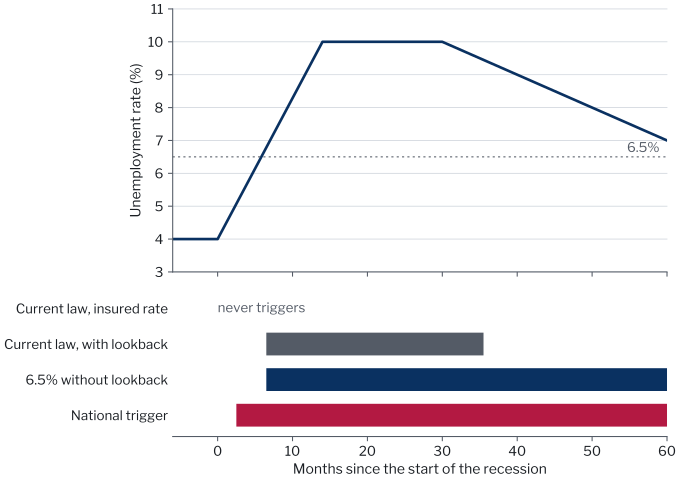
Scroll sideways for the whole figure
Data table
| Month since recession start | Unemployment rate (%) | Current law, insured rate | Current law, with lookback | 6.5% without lookback | National trigger |
|---|---|---|---|---|---|
| −6 | 4.00 | Off | Off | Off | Off |
| −5 | 4.00 | Off | Off | Off | Off |
| −4 | 4.00 | Off | Off | Off | Off |
| −3 | 4.00 | Off | Off | Off | Off |
| −2 | 4.00 | Off | Off | Off | Off |
| −1 | 4.00 | Off | Off | Off | Off |
| 0 | 4.00 | Off | Off | Off | Off |
| 1 | 4.43 | Off | Off | Off | Off |
| 2 | 4.86 | Off | Off | Off | Off |
| 3 | 5.29 | Off | Off | Off | On |
| 4 | 5.71 | Off | Off | Off | On |
| 5 | 6.14 | Off | Off | Off | On |
| 6 | 6.57 | Off | Off | Off | On |
| 7 | 7.00 | Off | On | On | On |
| 8 | 7.43 | Off | On | On | On |
| 9 | 7.86 | Off | On | On | On |
| 10 | 8.29 | Off | On | On | On |
| 11 | 8.71 | Off | On | On | On |
| 12 | 9.14 | Off | On | On | On |
| 13 | 9.57 | Off | On | On | On |
| 14 | 10.00 | Off | On | On | On |
| 15 | 10.00 | Off | On | On | On |
| 16 | 10.00 | Off | On | On | On |
| 17 | 10.00 | Off | On | On | On |
| 18 | 10.00 | Off | On | On | On |
| 19 | 10.00 | Off | On | On | On |
| 20 | 10.00 | Off | On | On | On |
| 21 | 10.00 | Off | On | On | On |
| 22 | 10.00 | Off | On | On | On |
| 23 | 10.00 | Off | On | On | On |
| 24 | 10.00 | Off | On | On | On |
| 25 | 10.00 | Off | On | On | On |
| 26 | 10.00 | Off | On | On | On |
| 27 | 10.00 | Off | On | On | On |
| 28 | 10.00 | Off | On | On | On |
| 29 | 10.00 | Off | On | On | On |
| 30 | 10.00 | Off | On | On | On |
| 31 | 9.90 | Off | On | On | On |
| 32 | 9.80 | Off | On | On | On |
| 33 | 9.70 | Off | On | On | On |
| 34 | 9.60 | Off | On | On | On |
| 35 | 9.50 | Off | On | On | On |
| 36 | 9.40 | Off | Off | On | On |
| 37 | 9.30 | Off | Off | On | On |
| 38 | 9.20 | Off | Off | On | On |
| 39 | 9.10 | Off | Off | On | On |
| 40 | 9.00 | Off | Off | On | On |
| 41 | 8.90 | Off | Off | On | On |
| 42 | 8.80 | Off | Off | On | On |
| 43 | 8.70 | Off | Off | On | On |
| 44 | 8.60 | Off | Off | On | On |
| 45 | 8.50 | Off | Off | On | On |
| 46 | 8.40 | Off | Off | On | On |
| 47 | 8.30 | Off | Off | On | On |
| 48 | 8.20 | Off | Off | On | On |
| 49 | 8.10 | Off | Off | On | On |
| 50 | 8.00 | Off | Off | On | On |
| 51 | 7.90 | Off | Off | On | On |
| 52 | 7.80 | Off | Off | On | On |
| 53 | 7.70 | Off | Off | On | On |
| 54 | 7.60 | Off | Off | On | On |
| 55 | 7.50 | Off | Off | On | On |
| 56 | 7.40 | Off | Off | On | On |
| 57 | 7.30 | Off | Off | On | On |
| 58 | 7.20 | Off | Off | On | On |
| 59 | 7.10 | Off | Off | On | On |
| 60 | 7.00 | Off | Off | On | On |
Scroll sideways for all columns
The simulation is deliberately simple. Actual unemployment paths differ across states and are noisier, and real triggers use data that are published with a lag, which would delay every rule by a month or more. But the qualitative conclusions do not depend on these details: a trigger based on the level of the insured rate cannot activate when few unemployed workers receive benefits, a lookback fails in long recessions by design, and a trigger based on the change in unemployment reacts sooner than one based on its level.
5. Benefits and costs of earlier, longer extensions
The case for extending benefits in recessions rests on the trade-off between insurance and incentives that is at the heart of the theory of unemployment insurance (Baily 1978; Chetty 2008). Longer benefits help households maintain consumption: spending falls sharply when benefits are exhausted (Ganong and Noel 2019), and the large benefit supplements paid in 2020 were largely spent while reducing job finding only modestly (Ganong et al. 2024). The incentive costs appear to be smaller when unemployment is high. Kroft and Notowidigdo (2016) find that the moral hazard cost of benefits is lower when unemployment is high, and Landais, Michaillat, and Saez (2018a, 2018b) show that when jobs are rationed, optimal unemployment insurance is more generous in recessions.
The evidence on the effect of the extensions of 2008 to 2013 on unemployment points to modest effects. Rothstein (2011) and Farber and Valletta (2015) find that extensions raised the duration of unemployment by small amounts, largely by keeping people in the labor force rather than by reducing job finding. Schmieder, von Wachter, and Bender (2012), using German data, find that the effects of longer potential benefit durations on nonemployment change little over the business cycle. Chodorow-Reich, Coglianese, and Karabarbounis (2019), using a measurement error approach, find that the macroeconomic effects of benefit extensions on unemployment were small. Benefit levels also affect the duration of claims (Card et al. 2015).
Whether earlier extensions would stabilize the economy is less certain. Quantitative models with nominal rigidities give unemployment insurance a role in stabilizing aggregate demand (McKay and Reis 2016; Kekre 2023), and regions with more generous benefits appear less exposed to local shocks (Di Maggio and Kermani 2016). But Chodorow-Reich and Coglianese (2019) caution that, early in a recession, few people have been unemployed long enough to exhaust regular benefits, so extensions add little to aggregate spending until unemployment has been high for some time. The main argument for earlier triggers is therefore insurance, not stimulus: extensions should be in place before the first workers laid off in a recession exhaust their regular benefits, which in most states happens about six months after the first layoffs.
6. Implications for policy
We separate what the evidence shows from what we recommend.
What the evidence shows. The current mandatory trigger is unlikely to activate in a recession of any size while benefit receipt remains low. The optional trigger activates months into a recession and, because of the lookback, can switch off while unemployment is still high. A trigger based on a rise in national unemployment would activate months earlier. The incentive costs of extended benefits appear modest in recessions, and their main benefit is insurance for long-term unemployed workers.
What we recommend.
- A national on-trigger. Make Extended Benefits available in every state when the three-month average national unemployment rate rises by 0.5 points above its low of the previous 12 months, so that extensions are in place before regular benefits run out for workers laid off early in a recession.
- State triggers without a lookback. Keep state triggers based on the level of total unemployment, with additional tiers at higher rates as Chodorow-Reich and Coglianese (2019) propose, and remove the lookback so that benefits stay available while unemployment is high.
- Full federal financing. Pay the full cost of Extended Benefits from federal funds, so that states do not weigh the cost against other needs in a recession, and make the optional triggers mandatory.
- A gradual off-trigger. Phase benefits out as unemployment falls, rather than ending them abruptly, to avoid cliffs for recipients.
These changes would raise federal spending only in recessions. Their cost depends on how many people reach long-term unemployment, which, as the simulation shows, is largest exactly when the current triggers fail.
7. Limits of this analysis
Our simulation uses stylized paths and a fixed ratio of insured to total unemployment, and it ignores differences across states and data revisions. We do not estimate the budgetary cost of the proposals, which would require a model of how many workers exhaust regular benefits in each scenario. The evidence on incentive effects comes mostly from the 2008 to 2013 extensions and may not apply to a recession with a different character. Finally, our recommendations concern the timing of extensions, not the generosity or coverage of regular benefits, which also determine how well unemployment insurance works in a recession.
Declarations
- Ethics approval and consent to participate
- Not applicable. The study involved no human participants.
- Data availability
- The paper uses no confidential data. The simulation in Section 4 applies the stated trigger rules to stylized unemployment paths defined in the text. The replication package contains the code that generates the paths, applies the rules and produces Table 1 and Figure 1, with a README that follows the Social Science Data Editors template. Because this is a demonstration article, no replication package has been deposited and no repository DOI exists.
- Use of generative AI
- This demonstration article, including its text, its fictional data and results, its figures and the selection of its references, was generated with a generative AI tool (Claude, Anthropic) to preview the journal's design. Every reference was checked against Crossref or a publisher or library record. In a published article, this statement names each generative AI tool used, with its version and provider, the purpose of its use, the parts of the manuscript affected and how the authors checked the output, as the journal's policy on generative AI requires. Under that policy, generative AI may be used in a policy perspective only for language editing, and that use must be declared.
- Funding
- The authors received no specific funding for this work.
- Competing interests
- Each author submitted a disclosure statement. Neither author has received support from any party with an interest in unemployment insurance policy. The authors have nothing to disclose.
- Author contributions (CRediT)
-
- Conceptualization
- H.W.-D.
- Formal analysis
- O.F.S.
- Software
- O.F.S.
- Writing, original draft
- H.W.-D.
- Writing, review and editing
- O.F.S.
- Acknowledgments
- This is a demonstration article created to preview the journal's design. The study, its data and its authors are fictional. It has not been peer reviewed, and its received, revised, accepted and published dates are illustrative.
References
- 1.Baily, Martin Neil. 1978. “Some Aspects of Optimal Unemployment Insurance.” Journal of Public Economics 10 (3): 379-402. https://doi.org/10.1016/0047-2727(78)90053-1. DOIGoogle Scholar
- 2.Card, David, Andrew Johnston, Pauline Leung, Alexandre Mas, and Zhuan Pei. 2015. “The Effect of Unemployment Benefits on the Duration of Unemployment Insurance Receipt: New Evidence from a Regression Kink Design in Missouri, 2003-2013.” American Economic Review 105 (5): 126-130. https://doi.org/10.1257/aer.p20151061. DOIGoogle Scholar
- 3.Chetty, Raj. 2008. “Moral Hazard versus Liquidity and Optimal Unemployment Insurance.” Journal of Political Economy 116 (2): 173-234. https://doi.org/10.1086/588585. DOIGoogle Scholar
- 4.Chodorow-Reich, Gabriel, and John Coglianese. 2019. “Unemployment Insurance and Macroeconomic Stabilization.” In Recession Ready: Fiscal Policies to Stabilize the American Economy, edited by Heather Boushey, Ryan Nunn, and Jay Shambaugh, 153-179. Washington, DC: The Hamilton Project and the Washington Center for Equitable Growth. https://www.brookings.edu/wp-content/uploads/2019/05/AutomaticStabilizers_FullBook_web_20190508.pdf. Full textGoogle Scholar
- 5.Chodorow-Reich, Gabriel, John Coglianese, and Loukas Karabarbounis. 2019. “The Macro Effects of Unemployment Benefit Extensions: A Measurement Error Approach.” Quarterly Journal of Economics 134 (1): 227-279. https://doi.org/10.1093/qje/qjy018. DOIGoogle Scholar
- 6.Di Maggio, Marco, and Amir Kermani. 2016. “The Importance of Unemployment Insurance as an Automatic Stabilizer.” NBER Working Paper 22625. https://doi.org/10.3386/w22625. DOIGoogle Scholar
- 7.Farber, Henry S., and Robert G. Valletta. 2015. “Do Extended Unemployment Benefits Lengthen Unemployment Spells? Evidence from Recent Cycles in the U.S. Labor Market.” Journal of Human Resources 50 (4): 873-909. https://doi.org/10.3368/jhr.50.4.873. DOIGoogle Scholar
- 8.Ganong, Peter, and Pascal Noel. 2019. “Consumer Spending during Unemployment: Positive and Normative Implications.” American Economic Review 109 (7): 2383-2424. https://doi.org/10.1257/aer.20170537. DOIGoogle Scholar
- 9.Ganong, Peter, Fiona Greig, Pascal Noel, Daniel M. Sullivan, and Joseph Vavra. 2024. “Spending and Job-Finding Impacts of Expanded Unemployment Benefits: Evidence from Administrative Micro Data.” American Economic Review 114 (9): 2898-2939. https://doi.org/10.1257/aer.20220973. DOIGoogle Scholar
- 10.Kekre, Rohan. 2023. “Unemployment Insurance in Macroeconomic Stabilization.” Review of Economic Studies 90 (5): 2439-2480. https://doi.org/10.1093/restud/rdac080. DOIGoogle Scholar
- 11.Kroft, Kory, and Matthew J. Notowidigdo. 2016. “Should Unemployment Insurance Vary with the Unemployment Rate? Theory and Evidence.” Review of Economic Studies 83 (3): 1092-1124. https://doi.org/10.1093/restud/rdw009. DOIGoogle Scholar
- 12.Landais, Camille, Pascal Michaillat, and Emmanuel Saez. 2018a. “A Macroeconomic Approach to Optimal Unemployment Insurance: Theory.” American Economic Journal: Economic Policy 10 (2): 152-181. https://doi.org/10.1257/pol.20150088. DOIGoogle Scholar
- 13.Landais, Camille, Pascal Michaillat, and Emmanuel Saez. 2018b. “A Macroeconomic Approach to Optimal Unemployment Insurance: Applications.” American Economic Journal: Economic Policy 10 (2): 182-216. https://doi.org/10.1257/pol.20160462. DOIGoogle Scholar
- 14.McKay, Alisdair, and Ricardo Reis. 2016. “The Role of Automatic Stabilizers in the U.S. Business Cycle.” Econometrica 84 (1): 141-194. https://doi.org/10.3982/ECTA11574. DOIGoogle Scholar
- 15.Rothstein, Jesse. 2011. “Unemployment Insurance and Job Search in the Great Recession.” Brookings Papers on Economic Activity 2011 (2): 143-213. https://doi.org/10.1353/eca.2011.0018. DOIGoogle Scholar
- 16.Sahm, Claudia. 2019. “Direct Stimulus Payments to Individuals.” In Recession Ready: Fiscal Policies to Stabilize the American Economy, edited by Heather Boushey, Ryan Nunn, and Jay Shambaugh, 67-92. Washington, DC: The Hamilton Project and the Washington Center for Equitable Growth. https://www.brookings.edu/wp-content/uploads/2019/05/AutomaticStabilizers_FullBook_web_20190508.pdf. Full textGoogle Scholar
- 17.Schmieder, Johannes F., Till von Wachter, and Stefan Bender. 2012. “The Effects of Extended Unemployment Insurance over the Business Cycle: Evidence from Regression Discontinuity Estimates over 20 Years.” Quarterly Journal of Economics 127 (2): 701-752. https://doi.org/10.1093/qje/qjs010. DOIGoogle Scholar
About this article
- Journal
- Global Economies: Economics, Finance and Public Policy
- Volume and article
- Volume 1 (2026), article 6
- Article type and section
- Policy perspective, Public Finance
- DOI
- Not yet assigned. Crossref membership pending.
- Publisher
- Eldenhall Sciences Inc., Harrisonville, Missouri, United States
- History
- Demo dates: received June 29, 2026; revised August 31, 2026; accepted September 28, 2026; published October 20, 2026
- Peer review
- Not peer reviewed: this is a demo article. A published article names its review model here (double-blind, external reviewers) and its handling editor.
- License
- Creative Commons Attribution 4.0 International (CC BY 4.0)
- Status
- Demo article for the site design. Not real research, not indexed, not citable.
Rights and citation
Copyright 2026 the authors. This is an open access article distributed under the terms of the Creative Commons Attribution 4.0 International License, which permits use, sharing, adaptation, distribution and reproduction in any medium or format, provided the original authors and source are credited.
Cite this article (Chicago)
Weiss-Delgado, Hannah, and Omar Farouk Siddiqui. 2026. "Fixing the triggers: making extended unemployment benefits arrive on time in the next U.S. recession." Global Economies 1: 6. https://eldenhall.org/articles/extended-benefits-trigger-design/. [Demo article]