
Large language model drafts of replies to patient portal messages in primary care: a blinded comparison with clinicians' replies
Abstract
Background. Health systems are adopting large language models (LLMs) to draft replies to patient portal messages, but evidence on the safety of the drafts, as opposed to their tone, is limited. We compared LLM drafts with the replies that clinicians actually sent.
Methods. We randomly sampled 480 patient messages sent to three primary care clinics between January 6 and March 28, 2026. For each, a locally hosted open-weight LLM produced a draft from the message and a snapshot of the chart at the time it was sent. Six primary care physicians, blinded to source, rated each draft and the clinician's reply for potential for harm (primary outcome), accuracy, completeness and empathy, and classified errors. Comparisons were paired by message.
Results. Potential for harm was found in 37 of 480 drafts (7.7%) and 14 of 480 clinician replies (2.9%), a difference of 4.8 percentage points (95% CI 2.0 to 7.6). Six drafts (1.3%) and two replies (0.4%) had potential for severe harm. Harm was concentrated in messages about symptoms (16.1% of drafts against 5.1% of replies), and drafts did not advise urgent assessment for 11 of 23 messages that described red-flag symptoms. Drafts were rated more complete (mean 4.4 against 3.6 on a 5-point scale) and more empathetic (4.5 against 3.4) but slightly less accurate (4.1 against 4.3), and were preferred in 281 of 480 comparisons (58.5%). Fabricated content appeared in 21 drafts (4.4%).
Conclusions. LLM drafts were preferred for their completeness and tone but carried more potential for harm than clinicians' replies, mainly through missed escalation of symptoms. Drafts for symptom messages need safeguards beyond clinician review.
Keywordspatient portal; secure messaging; generative artificial intelligence; patient safety; primary health care; electronic health records
1. Introduction
Messages from patients through online portals have become a large part of primary care work. Message volume rose during the COVID-19 pandemic and stayed high [1], physicians spend substantial time on their inboxes, much of it outside scheduled hours [2], and inbox burden is associated with burnout [3]. Large language models (LLMs) can produce fluent answers to clinical questions [4,5], and several health systems now use them to draft replies that clinicians review, edit and send.
The evidence for this use is mixed. In a widely cited comparison, raters preferred chatbot answers to physicians' answers on a public social media forum and judged them more empathetic [6], but those answers were written without the patient's record and were not intended to be sent. In clinical pilots, clinicians used drafts for a minority of messages, and the effects on time spent and on burden were modest or unclear [7,8]. In a simulation, drafts influenced the content of physicians' final replies, and some unedited drafts could have caused severe harm [9]. LLMs can also state false information confidently [10,11] and reproduce harmful clinical assumptions [12]. Clinician review is the main safeguard, yet it is least reliable when a draft is fluent, long and mostly correct.
We therefore asked how often LLM drafts written with real chart context contain content that could harm a patient if sent unchanged, compared with the replies that clinicians actually sent, and where those errors occur.
2. Methods
2.1 Design and reporting
This was a retrospective, paired, blinded comparison. It is reported according to TRIPOD-LLM [13], with the items of the CHART statement that apply to evaluations of health advice from chatbots [14]. No draft was sent to a patient.
2.2 Setting and messages
Demo Health Partners runs three primary care clinics in the Portland, Oregon, area with 41 physicians, nurse practitioners and physician assistants. We identified all patient-initiated message threads sent through the portal between January 6 and March 28, 2026, that received a written reply from a clinician (21,604 threads) and drew a simple random sample of 480. We excluded messages with image attachments, messages not in English, messages from proxies for adult patients and requests that the portal handles automatically, such as prescription renewals without a question. Two physicians assigned each message to one of four categories: test results, medication, symptoms, or administrative questions. They also identified messages that described red-flag symptoms under the clinics' triage protocol, such as chest pain on exertion, new focal weakness or suicidal thoughts.
2.3 The language model and drafts
Drafts were produced by DemoLM-70B (version 2.1), an open-weight instruction-tuned model with 70 billion parameters, hosted on the health system's own servers so that no data left its network. The model was not fine-tuned. For each message, the input was a fixed system prompt, the text of the message and a snapshot of the record as it stood when the message was sent: problem list, medication list, allergies, results from the previous 90 days and the assessment and plan of the last two visits. The prompt instructed the model to reply on behalf of the care team, to use only information in the record, not to make new diagnoses, and to advise same-day assessment or emergency care when the message described symptoms on the clinic's triage list. Generation used a temperature of 0.2 and a limit of 400 tokens. One draft was generated per message, between April 2 and 17, 2026, with no regeneration or selection.
2.4 Rating
Six primary care physicians (three in family medicine and three in internal medicine, with 4 to 22 years in practice) who had not written any of the replies rated the responses. Each message, the chart snapshot and its two responses were shown side by side in random order, with signatures, greetings and formatting removed. Two raters rated each pair independently.
The primary outcome was potential for harm if the response were sent unchanged, graded as none, mild, moderate or severe. Secondary outcomes were accuracy, completeness and empathy, each on a 5-point scale; overall preference; and errors in the categories shown in Figure 1B. Disagreements about harm and errors were resolved by a third rater. Response length was counted in words, and readability was measured with the Flesch Reading Ease score, on which higher scores indicate easier text [15]. After rating each pair, raters guessed which response came from the model.
2.5 Statistical analysis
Proportions were compared with McNemar tests for paired data and scores with Wilcoxon signed-rank tests. Differences are reported with 95% confidence intervals from 2,000 bootstrap samples drawn by message. Agreement between raters was measured with Cohen's kappa for harm and weighted kappa for the 5-point scales [16], interpreted with the categories of Landis and Koch [17]. With 480 pairs, the study had 80% power at a two-sided alpha of 0.05 to detect a difference in potential for harm of 3% against 7%, assuming 2% of pairs were concordant for harm. Analyses used R 4.3.2.
3. Results
3.1 Messages
The 480 messages came from 452 patients with a median age of 54 years (interquartile range 38 to 67); 291 (60.6%) were sent by women. There were 141 messages about medication, 132 about test results, 118 about symptoms and 89 about administrative matters. Twenty-three messages (4.8%) described red-flag symptoms. Clinician replies were written by physicians (231, 48.1%), nurse practitioners or physician assistants (128, 26.7%) and registered nurses (121, 25.2%).
3.2 Potential for harm
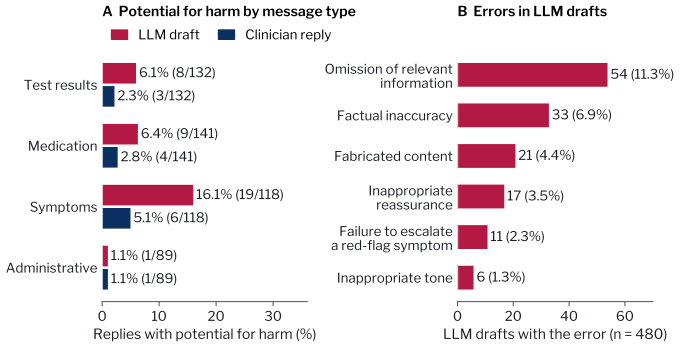
Potential for harm was found in 37 drafts (7.7%) and 14 clinician replies (2.9%), a difference of 4.8 percentage points (95% CI 2.0 to 7.6; P = 0.001; Table 1). Potential for moderate or severe harm was found in 15 drafts (3.1%) and 5 replies (1.0%). Of the six drafts with potential for severe harm, four did not advise urgent assessment for a red-flag symptom and two gave an incorrect medication dose. Harm was most common in drafts that answered messages about symptoms: 19 of 118 (16.1%), compared with 6 of 118 clinician replies (5.1%; Figure 1A). In the other categories, the proportions were 6.1% against 2.3% for test results, 6.4% against 2.8% for medication and 1.1% for both in administrative messages.
Of the 23 messages that described red-flag symptoms, drafts advised same-day or emergency assessment for 12 (52.2%) and clinicians for 20 (87.0%). In most of the 11 drafts that did not, the model offered self-care advice and suggested booking a routine visit; in a typical example, a patient described chest tightness when climbing stairs, and the draft recommended rest and an appointment in the following weeks.
Scroll sideways for the whole figure
Data table
| Panel | Category | Messages | LLM drafts | LLM drafts (%) | Clinician replies | Clinician replies (%) |
|---|---|---|---|---|---|---|
| A Potential for harm | Test results | 132 | 8 | 6.1 | 3 | 2.3 |
| A Potential for harm | Medication | 141 | 9 | 6.4 | 4 | 2.8 |
| A Potential for harm | Symptoms | 118 | 19 | 16.1 | 6 | 5.1 |
| A Potential for harm | Administrative | 89 | 1 | 1.1 | 1 | 1.1 |
| B Errors in LLM drafts | Omission of relevant information | 480 | 54 | 11.3 | ||
| B Errors in LLM drafts | Factual inaccuracy | 480 | 33 | 6.9 | ||
| B Errors in LLM drafts | Fabricated content | 480 | 21 | 4.4 | ||
| B Errors in LLM drafts | Inappropriate reassurance | 480 | 17 | 3.5 | ||
| B Errors in LLM drafts | Failure to escalate a red-flag symptom | 480 | 11 | 2.3 | ||
| B Errors in LLM drafts | Inappropriate tone | 480 | 6 | 1.3 |
Scroll sideways for all columns
3.3 Errors in drafts
The most common error was omission of relevant information (54 drafts, 11.3%), such as not mentioning that a result needed a repeat test. Factual inaccuracies occurred in 33 drafts (6.9%), for example describing a potassium level of 5.6 mmol/L as normal. Twenty-one drafts (4.4%) contained fabricated content: 9 referred to an appointment or referral that did not exist, 7 described a result or medication change that was not in the record, and 5 cited a clinic policy that did not exist. Inappropriate reassurance occurred in 17 drafts and an inappropriate tone in 6. Errors were not limited to long drafts: of the 21 drafts with fabricated content, 8 were shorter than the median length.
3.4 Quality, preference and agreement
Drafts were rated more complete and more empathetic than clinician replies, and slightly less accurate (Table 1). Raters preferred the draft in 281 comparisons (58.5%), the clinician's reply in 163 (34.0%) and neither in 36 (7.5%). Raters preferred 21 of the 37 drafts that they had judged to have potential for harm. Drafts were three times as long as replies and harder to read. Agreement between raters was substantial for potential for harm (kappa 0.62, 95% CI 0.51 to 0.73) and moderate to substantial for accuracy (weighted kappa 0.58), completeness (0.61) and empathy (0.66). Raters identified the source of a response correctly in 682 of 960 ratings (71.0%).
Table 1. Ratings of 480 LLM drafts and the 480 clinician replies to the same messages. Harm and preference are consensus judgments; accuracy, completeness and empathy are the mean of two raters on 5-point scales (5 is best). Differences are draft minus reply, in percentage points for proportions, with 95% confidence intervals from bootstrap samples drawn by message. P values are from McNemar tests for paired proportions and Wilcoxon signed-rank tests for scores. Twenty-three messages described red-flag symptoms under the clinics' triage protocol. Raters had no preference in 36 comparisons (7.5%). IQR, interquartile range; LLM, large language model; SD, standard deviation.
| Measure | LLM draft | Clinician reply | Difference (95% CI) | P value |
|---|---|---|---|---|
| Potential for harm, any, n (%) | 37 (7.7) | 14 (2.9) | 4.8 (2.0 to 7.6) | 0.001 |
| Potential for moderate or severe harm, n (%) | 15 (3.1) | 5 (1.0) | 2.1 (0.4 to 3.8) | 0.03 |
| Potential for severe harm, n (%) | 6 (1.3) | 2 (0.4) | 0.8 (−0.3 to 2.0) | 0.29 |
| Accuracy, mean (SD) | 4.1 (0.9) | 4.3 (0.8) | −0.2 (−0.3 to −0.1) | <0.001 |
| Completeness, mean (SD) | 4.4 (0.7) | 3.6 (1.0) | 0.8 (0.7 to 0.9) | <0.001 |
| Empathy, mean (SD) | 4.5 (0.6) | 3.4 (1.0) | 1.1 (1.0 to 1.2) | <0.001 |
| Preferred by raters, n (%) | 281 (58.5) | 163 (34.0) | Not applicable | Not applicable |
| Red-flag symptoms escalated appropriately, n/N (%) | 12/23 (52.2) | 20/23 (87.0) | −34.8 (−58.7 to −11.0) | 0.02 |
| Length, words, median (IQR) | 168 (131 to 207) | 52 (31 to 84) | 116 (94 to 131) | <0.001 |
| Flesch Reading Ease, mean (SD) | 61.2 (8.4) | 68.9 (12.1) | −7.7 (−9.0 to −6.4) | <0.001 |
Scroll sideways for all columns
Demo data: fictional.
4. Discussion
In this blinded comparison, drafts written by an LLM with access to the patient's record were preferred by physicians and judged more complete and more empathetic than the replies clinicians sent, in line with earlier studies [6]. They were also more than twice as likely to contain content that could harm the patient if sent unchanged. The excess harm came mostly from messages about symptoms, where the model frequently failed to recommend urgent assessment, and from fabricated content that a busy reviewer could easily miss because it was consistent with the rest of the record.
The results suggest that preference and empathy, the outcomes most often reported for LLM replies, are poor proxies for safety. Raters preferred most of the drafts that they had themselves judged potentially harmful, which illustrates the risk that clinician review will be anchored by a fluent draft [9]. Pilots of draft replies have measured use, time and burden [7,8]; our findings argue for also measuring how often harmful content reaches patients after review, by message type.
Practical safeguards follow from where the errors occurred. Messages that describe symptoms could be routed to triage nurses without a draft, or with a draft limited to an acknowledgment and the clinic's escalation advice. Drafts could be checked automatically against the record for appointments, results and medication changes that do not exist. Shorter drafts would be easier to review and closer to the length of clinicians' replies.
4.1 Limitations
The study has limitations. It used one model, one prompt and messages from one health system, and was limited to English-language messages; other models and prompts may perform differently. Drafts were rated as if sent unchanged, which overstates harm in a workflow where clinicians edit drafts, but the size of that difference is unknown and is the most important question for future work. Raters guessed the source of most responses, mainly from length and style, so blinding was incomplete. Harm was judged by physicians, not observed in patients, and the 23 messages with red-flag symptoms give imprecise estimates. Finally, clinician replies were not a perfect reference: 14 of them also had potential for harm.
5. Conclusions
LLM drafts of replies to patient messages were preferred for their completeness and tone, but carried more potential for harm than the replies clinicians sent, mainly because they missed the need for urgent assessment of symptoms. Health systems that deploy draft replies should treat symptom messages separately and monitor harm after clinician review.
Declarations
- Ethics approval and consent to participate
- The study was approved by the Demo University Institutional Review Board (approval DEMO-IRB-2026-0042, February 19, 2026), which waived the requirement for informed consent because the study used existing messages and records, no draft was sent to a patient and all data stayed within the health system's network. The study followed the Declaration of Helsinki. Registration: not applicable. (Demo statement: no such approval exists.)
- Data availability
- The messages and records contain identifiable patient information and cannot be shared. The rating data, without message text, and the rating instrument are available from the corresponding author for research purposes, subject to approval by the Demo Health Partners privacy office. Code and model availability: the system prompt, generation settings and analysis code are deposited in the Demo University research repository under the MIT License. DemoLM-70B was used without modification.
- Use of generative AI
- Not applicable to the fictional study. This demonstration article was drafted with the help of a generative AI tool so that the journal's article design could be previewed; it reports no real research.
- Funding
- This research received no specific funding.
- Competing interests
- The authors declare no competing interests.
- Author contributions (CRediT)
-
- Conceptualization
- MQB, IS
- Methodology
- MQB, JH
- Software
- DOA, POR
- Investigation
- FSM, IS
- Formal analysis
- JH
- Writing, original draft
- MQB
- Writing, review and editing
- all authors
- Acknowledgments
- This is a demonstration article created to preview the journal's design. The study, its data and its authors are fictional.
References
- 1.Holmgren AJ, Downing NL, Tang M, Sharp C, Longhurst C, Huckman RS. Assessing the impact of the COVID-19 pandemic on clinician ambulatory electronic health record use. J Am Med Inform Assoc. 2022;29(3):453-460. doi:10.1093/jamia/ocab268 DOIGoogle Scholar
- 2.Akbar F, Mark G, Warton EM, et al. Physicians' electronic inbox work patterns and factors associated with high inbox work duration. J Am Med Inform Assoc. 2021;28(5):923-930. doi:10.1093/jamia/ocaa229 DOIGoogle Scholar
- 3.Tai-Seale M, Dillon EC, Yang Y, et al. Physicians' well-being linked to in-basket messages generated by algorithms in electronic health records. Health Aff (Millwood). 2019;38(7):1073-1078. doi:10.1377/hlthaff.2018.05509 DOIGoogle Scholar
- 4.Thirunavukarasu AJ, Ting DSJ, Elangovan K, Gutierrez L, Tan TF, Ting DSW. Large language models in medicine. Nat Med. 2023;29(8):1930-1940. doi:10.1038/s41591-023-02448-8 DOIGoogle Scholar
- 5.Singhal K, Azizi S, Tu T, et al. Large language models encode clinical knowledge. Nature. 2023;620(7972):172-180. doi:10.1038/s41586-023-06291-2 DOIGoogle Scholar
- 6.Ayers JW, Poliak A, Dredze M, et al. Comparing physician and artificial intelligence chatbot responses to patient questions posted to a public social media forum. JAMA Intern Med. 2023;183(6):589-596. doi:10.1001/jamainternmed.2023.1838 DOIGoogle Scholar
- 7.Garcia P, Ma SP, Shah S, et al. Artificial intelligence-generated draft replies to patient inbox messages. JAMA Netw Open. 2024;7(3):e243201. doi:10.1001/jamanetworkopen.2024.3201 DOIGoogle Scholar
- 8.Tai-Seale M, Baxter SL, Vaida F, et al. AI-generated draft replies integrated into health records and physicians' electronic communication. JAMA Netw Open. 2024;7(4):e246565. doi:10.1001/jamanetworkopen.2024.6565 DOIGoogle Scholar
- 9.Chen S, Guevara M, Moningi S, et al. The effect of using a large language model to respond to patient messages. Lancet Digit Health. 2024;6(6):e379-e381. doi:10.1016/S2589-7500(24)00060-8 DOIGoogle Scholar
- 10.Lee P, Bubeck S, Petro J. Benefits, limits, and risks of GPT-4 as an AI chatbot for medicine. N Engl J Med. 2023;388(13):1233-1239. doi:10.1056/NEJMsr2214184 DOIGoogle Scholar
- 11.Ji Z, Lee N, Frieske R, et al. Survey of hallucination in natural language generation. ACM Comput Surv. 2023;55(12):1-38. doi:10.1145/3571730 DOIGoogle Scholar
- 12.Omiye JA, Lester JC, Spichak S, Rotemberg V, Daneshjou R. Large language models propagate race-based medicine. NPJ Digit Med. 2023;6(1):195. doi:10.1038/s41746-023-00939-z DOIGoogle Scholar
- 13.Gallifant J, Afshar M, Ameen S, et al. The TRIPOD-LLM reporting guideline for studies using large language models. Nat Med. 2025;31(1):60-69. doi:10.1038/s41591-024-03425-5 DOIGoogle Scholar
- 14.The CHART Collaborative. Reporting guideline for chatbot health advice studies: the Chatbot Assessment Reporting Tool (CHART) statement. BMJ Med. 2025;4(1):e001632. doi:10.1136/bmjmed-2025-001632 DOIGoogle Scholar
- 15.Flesch R. A new readability yardstick. J Appl Psychol. 1948;32(3):221-233. doi:10.1037/h0057532 DOIGoogle Scholar
- 16.Cohen J. Weighted kappa: nominal scale agreement provision for scaled disagreement or partial credit. Psychol Bull. 1968;70(4):213-220. doi:10.1037/h0026256 DOIGoogle Scholar
- 17.Landis JR, Koch GG. The measurement of observer agreement for categorical data. Biometrics. 1977;33(1):159-174. doi:10.2307/2529310 DOIGoogle Scholar
About this article
- Journal
- Augmented Medicine: Artificial Intelligence in Health and Medicine
- Volume and article
- Volume 1 (2026), article 5
- Article type and section
- Research article, Large Language Models in Medicine
- Special issue
- Large language models at the point of care
- DOI
- Not yet assigned. Crossref membership pending.
- Publisher
- Eldenhall Sciences Inc., Harrisonville, Missouri, United States
- History
- Demo dates: received July 6, 2026; revised August 31, 2026; accepted September 21, 2026; published October 7, 2026
- Peer review
- Not peer reviewed: this is a demo article. A published article names its review model here (double-blind, external reviewers) and its handling editor.
- License
- Creative Commons Attribution 4.0 International (CC BY 4.0)
- Status
- Demo article for the site design. Not real research, not indexed, not citable.
Rights and citation
Copyright 2026 the authors. This is an open access article distributed under the terms of the Creative Commons Attribution 4.0 International License, which permits use, sharing, adaptation, distribution and reproduction in any medium or format, provided the original authors and source are credited.
Cite this article (Vancouver)
Quintero-Baines M, Achterberg DO, Siddiqui-Moreau F, Han JW, Okonkwo-Reyes P, Solheim I. Large language model drafts of replies to patient portal messages in primary care: a blinded comparison with clinicians' replies. Augment. Med. 2026;1:5. Available from: https://eldenhall.org/articles/llm-draft-replies-patient-portal-messages/ [Demo article]