
Smartwatch irregular rhythm notifications in adults aged 75 years or older: accuracy against a 14-day patch electrocardiogram
Abstract
Smartwatch notifications of irregular rhythm are increasingly received by older adults, the group at highest risk of atrial fibrillation (AF) but least represented in validation studies. We studied 398 adults aged 75 years or older without known AF who wore a 14-day patch electrocardiogram while using their own smartwatch with notifications enabled. AF lasting 30 seconds or more was found in 41 participants (10.3%). Of 37 participants notified, 31 had AF (positive predictive value 83.8%, 95% CI 68.9 to 92.3). Notifications identified 31 of 41 participants with AF (sensitivity 75.6%); 8 of the 10 who were missed had less than 1 hour of AF in total. In this age group, a notification usually indicated AF, but the absence of one did not exclude short episodes of uncertain clinical significance.
Keywordsatrial fibrillation; wearable electronic devices; photoplethysmography; aged; 80 and over; mass screening; electrocardiography; ambulatory
1. Introduction
Atrial fibrillation (AF) is common in people aged 75 years or older, and even short, asymptomatic episodes are associated with stroke [1]. Systematic electrocardiogram (ECG) screening of people in their mid-seventies produced a small net benefit in a large randomized trial [2], while trials of anticoagulation for device-detected AF have shown that short episodes carry a lower risk than clinical AF and that treatment involves a real trade-off between stroke and bleeding [3,4]. Meanwhile, many older adults now own smartwatches that analyze the pulse with photoplethysmography and notify the wearer of an irregular rhythm.
Large studies of these notifications have reported high positive predictive values [5–7], but their participants were mostly younger than 65 years, and other studies found that accuracy varies between devices and that many recordings cannot be classified [8,9]. Older adults have more atrial ectopy, tremor and peripheral vascular disease, all of which can affect photoplethysmography. We measured the accuracy of notifications against continuous ECG in adults aged 75 years or older.
2. Methods
We enrolled adults aged 75 years or older without a history of AF who already used a smartwatch with an irregular rhythm notification feature cleared by the US Food and Drug Administration, from cardiology and primary care clinics at Demo University Medical Center, Denver, Colorado, between March and November 2025. Participants used watches from three manufacturers; results are reported for all devices together. Each participant wore a single-lead adhesive patch ECG for 14 days, a method that detects more arrhythmia than 24-hour Holter monitoring [10] and has been used in AF screening [11], while continuing to use the watch as usual. Notifications and their times were exported from the paired phone at the end of monitoring. Participants were asked to wear the watch for at least 12 hours a day, including at night if they were willing, and daily wear time was taken from the watch's activity record. Baseline characteristics, medications and comorbidities were taken from the medical record and confirmed at enrollment.
Two electrophysiologists, blinded to notifications, adjudicated the patch recordings. In line with guideline definitions, AF was defined as an episode of 30 seconds or more [12,13]; atrial flutter was counted as AF. A notification was counted as true positive if AF was present on the patch during the watch's analysis window. The primary outcome was the positive predictive value at the participant level. Secondary outcomes were sensitivity and specificity at the participant level, positive predictive value at the notification level and AF burden. Participants with less than 10 days of analyzable patch recording were excluded. Confidence intervals used the Wilson method, and for notifications a bootstrap clustered by participant. A sample of 400 participants was planned to estimate a positive predictive value of about 85% within 12 percentage points, assuming that 9% of participants would be notified.
3. Results
Of 412 participants enrolled, 398 had at least 10 days of analyzable recording (11 removed the patch early and 3 had data transfer failures). Their median age was 79 years (interquartile range 77 to 83), 210 (52.8%) were women, 162 (40.7%) had hypertension treated with two or more drugs and 71 (17.8%) had diabetes. The median analyzable recording was 13.6 days, and the median watch wear time was 15.2 hours a day (interquartile range 12.8 to 21.5).
AF was found in 41 participants (10.3%). Thirty-seven participants received at least one notification, and 31 of them had AF, a positive predictive value of 83.8% (95% CI 68.9 to 92.3; Table 1). Of the 63 notifications, 52 coincided with AF; the 11 false notifications occurred during frequent atrial ectopy (7) or motion artifact (4). Notifications identified 31 of the 41 participants with AF (sensitivity 75.6%), and specificity was 98.3%. The 10 participants with AF who received no notification had much less AF than those who did: median total burden 0.3 hours against 34.7 hours, and 8 of the 10 had less than 1 hour of AF over the recording (Figure 1). Among notified participants with AF, the first notification came a median of 2.1 days after the patch was applied, and 21 of the 52 true notifications occurred between midnight and 6 a.m.
No participant had a stroke or systemic embolism during monitoring. All 31 participants with AF and a notification, and 6 of the 10 without one, were referred to a cardiologist after the study; anticoagulation decisions were made by the treating clinicians and were not part of the study.
Table 1. Smartwatch irregular rhythm notifications against atrial fibrillation of 30 seconds or more on the 14-day patch electrocardiogram (398 participants). Confidence intervals are Wilson intervals, except for notifications, where a bootstrap clustered by participant was used.
| Notification status | Atrial fibrillation on patch | No atrial fibrillation on patch | Total |
|---|---|---|---|
| Participants with a notification | 31 | 6 | 37 |
| Participants without a notification | 10 | 351 | 361 |
| Total | 41 | 357 | 398 |
| Measure | n | % (95% CI) | |
| Positive predictive value, participants | 31 of 37 | 83.8 (68.9 to 92.3) | |
| Positive predictive value, notifications | 52 of 63 | 82.5 (70.9 to 91.2) | |
| Sensitivity | 31 of 41 | 75.6 (60.7 to 86.2) | |
| Specificity | 351 of 357 | 98.3 (96.4 to 99.2) | |
| Negative predictive value | 351 of 361 | 97.2 (95.0 to 98.5) | |
Scroll sideways for all columns
Demo data: fictional.
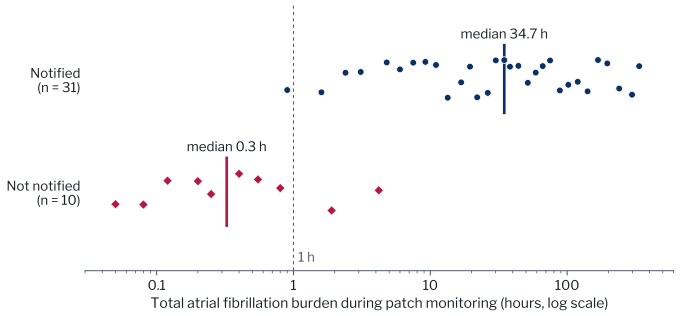
Scroll sideways for the whole figure
Data table
| Participant | Group | AF burden (hours) |
|---|---|---|
| 1 | Notified | 0.90 |
| 2 | Notified | 1.60 |
| 3 | Notified | 2.40 |
| 4 | Notified | 3.10 |
| 5 | Notified | 4.80 |
| 6 | Notified | 6.00 |
| 7 | Notified | 7.50 |
| 8 | Notified | 9.20 |
| 9 | Notified | 11.00 |
| 10 | Notified | 13.40 |
| 11 | Notified | 16.80 |
| 12 | Notified | 19.50 |
| 13 | Notified | 22.00 |
| 14 | Notified | 26.30 |
| 15 | Notified | 30.10 |
| 16 | Notified | 34.70 |
| 17 | Notified | 38.20 |
| 18 | Notified | 44.00 |
| 19 | Notified | 51.60 |
| 20 | Notified | 58.90 |
| 21 | Notified | 66.30 |
| 22 | Notified | 75.00 |
| 23 | Notified | 88.40 |
| 24 | Notified | 102.00 |
| 25 | Notified | 119.50 |
| 26 | Notified | 141.00 |
| 27 | Notified | 168.00 |
| 28 | Notified | 196.50 |
| 29 | Notified | 240.00 |
| 30 | Notified | 298.00 |
| 31 | Notified | 336.00 |
| 32 | Not notified | 0.05 |
| 33 | Not notified | 0.08 |
| 34 | Not notified | 0.12 |
| 35 | Not notified | 0.20 |
| 36 | Not notified | 0.25 |
| 37 | Not notified | 0.40 |
| 38 | Not notified | 0.55 |
| 39 | Not notified | 0.80 |
| 40 | Not notified | 1.90 |
| 41 | Not notified | 4.20 |
Scroll sideways for all columns
4. Discussion
In adults aged 75 years or older, about five in six participants who received an irregular rhythm notification had AF on a simultaneous ECG, a positive predictive value similar to that reported in younger populations [5]. Most false notifications occurred during frequent atrial ectopy, which is common at this age. Notifications missed a quarter of participants with AF, but almost all of them had less than an hour of AF in two weeks, a burden whose clinical significance is uncertain in light of recent anticoagulation trials [3,4].
For clinicians, the practical message is that a notification in an older adult warrants ECG confirmation, which will usually show AF, while the absence of notifications should not be taken as evidence that AF is absent. The study was small and done at one center, participants already owned smartwatches and were therefore not representative of all older adults, and results for individual devices could not be estimated with useful precision. Wear time also matters: notifications depend on the watch being worn, and older adults who remove the watch at night, when a large share of true notifications in this study occurred, will be notified less often. Whether notification-driven diagnosis in this age group improves outcomes needs a randomized evaluation that accounts for the bleeding risk of anticoagulation in older adults.
Declarations
- Ethics approval and consent to participate
- The study was approved by the Demo University Institutional Review Board (approval DEMO-IRB-2025-0061, February 21, 2025). All participants gave written informed consent. The study followed the Declaration of Helsinki. Registration: the study was observational and did not assign participants to an intervention; it was not registered. (Demo statement: no such approval exists.)
- Data availability
- De-identified participant-level data (adjudicated patch results, notification times and baseline characteristics) and a data dictionary are available from the corresponding author to researchers with an approved protocol, under a data use agreement. Code and model availability: the analysis code is deposited in the Demo University research repository under the MIT License. No model was developed; the notification algorithms are proprietary to the device manufacturers.
- Use of generative AI
- Not applicable to the fictional study. This demonstration article was drafted with the help of a generative AI tool so that the journal's article design could be previewed; it reports no real research.
- Funding
- This research received no specific funding. Patch monitors were purchased with departmental funds.
- Competing interests
- The authors declare no competing interests. No device manufacturer had any role in the study.
- Author contributions (CRediT)
-
- Conceptualization
- GOH, HS
- Investigation
- MTD, AF, HS
- Formal analysis
- OAC
- Writing, original draft
- GOH
- Writing, review and editing
- all authors
- Acknowledgments
- This is a demonstration article created to preview the journal's design. The study, its data and its authors are fictional.
References
- 1.Healey JS, Connolly SJ, Gold MR, et al. Subclinical atrial fibrillation and the risk of stroke. N Engl J Med. 2012;366(2):120-129. doi:10.1056/NEJMoa1105575 DOIGoogle Scholar
- 2.Svennberg E, Friberg L, Frykman V, Al-Khalili F, Engdahl J, Rosenqvist M. Clinical outcomes in systematic screening for atrial fibrillation (STROKESTOP): a multicentre, parallel group, unmasked, randomised controlled trial. Lancet. 2021;398(10310):1498-1506. doi:10.1016/S0140-6736(21)01637-8 DOIGoogle Scholar
- 3.Kirchhof P, Toennis T, Goette A, et al. Anticoagulation with edoxaban in patients with atrial high-rate episodes. N Engl J Med. 2023;389(13):1167-1179. doi:10.1056/NEJMoa2303062 DOIGoogle Scholar
- 4.Healey JS, Lopes RD, Granger CB, et al. Apixaban for stroke prevention in subclinical atrial fibrillation. N Engl J Med. 2024;390(2):107-117. doi:10.1056/NEJMoa2310234 DOIGoogle Scholar
- 5.Perez MV, Mahaffey KW, Hedlin H, et al. Large-scale assessment of a smartwatch to identify atrial fibrillation. N Engl J Med. 2019;381(20):1909-1917. doi:10.1056/NEJMoa1901183 DOIGoogle Scholar
- 6.Lubitz SA, Faranesh AZ, Selvaggi C, et al. Detection of atrial fibrillation in a large population using wearable devices: the Fitbit Heart Study. Circulation. 2022;146(19):1415-1424. doi:10.1161/CIRCULATIONAHA.122.060291 DOIGoogle Scholar
- 7.Guo Y, Wang H, Zhang H, et al. Mobile photoplethysmographic technology to detect atrial fibrillation. J Am Coll Cardiol. 2019;74(19):2365-2375. doi:10.1016/j.jacc.2019.08.019 DOIGoogle Scholar
- 8.Bumgarner JM, Lambert CT, Hussein AA, et al. Smartwatch algorithm for automated detection of atrial fibrillation. J Am Coll Cardiol. 2018;71(21):2381-2388. doi:10.1016/j.jacc.2018.03.003 DOIGoogle Scholar
- 9.Mannhart D, Lischer M, Knecht S, et al. Clinical validation of 5 direct-to-consumer wearable smart devices to detect atrial fibrillation. JACC Clin Electrophysiol. 2023;9(2):232-242. doi:10.1016/j.jacep.2022.09.011 DOIGoogle Scholar
- 10.Barrett PM, Komatireddy R, Haaser S, et al. Comparison of 24-hour Holter monitoring with 14-day novel adhesive patch electrocardiographic monitoring. Am J Med. 2014;127(1):95.e11-95.e17. doi:10.1016/j.amjmed.2013.10.003 DOIGoogle Scholar
- 11.Steinhubl SR, Waalen J, Edwards AM, et al. Effect of a home-based wearable continuous ECG monitoring patch on detection of undiagnosed atrial fibrillation: the mSToPS randomized clinical trial. JAMA. 2018;320(2):146-155. doi:10.1001/jama.2018.8102 DOIGoogle Scholar
- 12.Hindricks G, Potpara T, Dagres N, et al. 2020 ESC Guidelines for the diagnosis and management of atrial fibrillation developed in collaboration with the European Association for Cardio-Thoracic Surgery (EACTS). Eur Heart J. 2021;42(5):373-498. doi:10.1093/eurheartj/ehaa612 DOIGoogle Scholar
- 13.Joglar JA, Chung MK, Armbruster AL, et al. 2023 ACC/AHA/ACCP/HRS guideline for the diagnosis and management of atrial fibrillation: a report of the American College of Cardiology/American Heart Association Joint Committee on Clinical Practice Guidelines. Circulation. 2024;149(1):e1-e156. doi:10.1161/CIR.0000000000001193 DOIGoogle Scholar
About this article
- Journal
- Augmented Medicine: Artificial Intelligence in Health and Medicine
- Volume and article
- Volume 1 (2026), article 2
- Article type and section
- Short report, Digital Health and Wearables
- DOI
- Not yet assigned. Crossref membership pending.
- Publisher
- Eldenhall Sciences Inc., Harrisonville, Missouri, United States
- History
- Demo dates: received June 15, 2026; revised July 27, 2026; accepted August 10, 2026; published August 31, 2026
- Peer review
- Not peer reviewed: this is a demo article. A published article names its review model here (double-blind, external reviewers) and its handling editor.
- License
- Creative Commons Attribution 4.0 International (CC BY 4.0)
- Status
- Demo article for the site design. Not real research, not indexed, not citable.
Rights and citation
Copyright 2026 the authors. This is an open access article distributed under the terms of the Creative Commons Attribution 4.0 International License, which permits use, sharing, adaptation, distribution and reproduction in any medium or format, provided the original authors and source are credited.
Cite this article (Vancouver)
Ostrowska-Hale G, Delacroix MT, Fernhill A, Adebayo-Clarke O, Sandqvist H. Smartwatch irregular rhythm notifications in adults aged 75 years or older: accuracy against a 14-day patch electrocardiogram. Augment. Med. 2026;1:2. Available from: https://eldenhall.org/articles/smartwatch-atrial-fibrillation-notifications-older-adults/ [Demo article]